1.0 Introduction: Beyond Looking in the Rearview Mirror
Traditional business intelligence often feels like driving by looking only in the rearview mirror. You analyze historical data—what happened last week, last month, or last quarter—to make decisions about the road ahead. While useful, this approach leaves you blind to what's happening right now. In today's fast-paced environment, that delay can mean the difference between seizing an opportunity and missing it entirely.
Real-time analytics changes the game. It's less like a static map and more like a live GPS, providing instant updates based on current conditions. The ability to analyze and act on insights as events unfold is no longer a luxury; it is a critical strategic advantage that drives operational efficiency, improves customer experiences, and creates a powerful competitive edge.
2.0 What is Real-Time Analytics, in Plain English?
In simple terms, real-time analytics is the process of analyzing data the moment it becomes available to make better decisions quickly. Instead of waiting for data to be collected and processed in batches (e.g., in a nightly report), it leverages a continuous flow of information to provide immediate, context-aware insights.
There are two primary ways this happens, as defined by Gartner:
| Type | Business Analogy |
|---|---|
| On-Demand Analytics | "Asking your GPS for the current traffic conditions." (Waits for a user to ask a question). |
| Continuous Analytics | "Your GPS proactively alerting you to a traffic jam ahead." (Automatically sends alerts as events happen). |
3.0 Beyond Reports: What Real-Time Analytics Looks Like in Action
Real-time analytics moves beyond abstract dashboards to answer tangible, high-stakes business questions as events are happening. For a business leader, this means getting immediate answers to questions like:
- How many customers are in our store right now, and what are they most likely to buy?
- Which vehicles in our fleet are using the most fuel, and why?
- Is there a machinery in your factory that could fail in the next five business days?
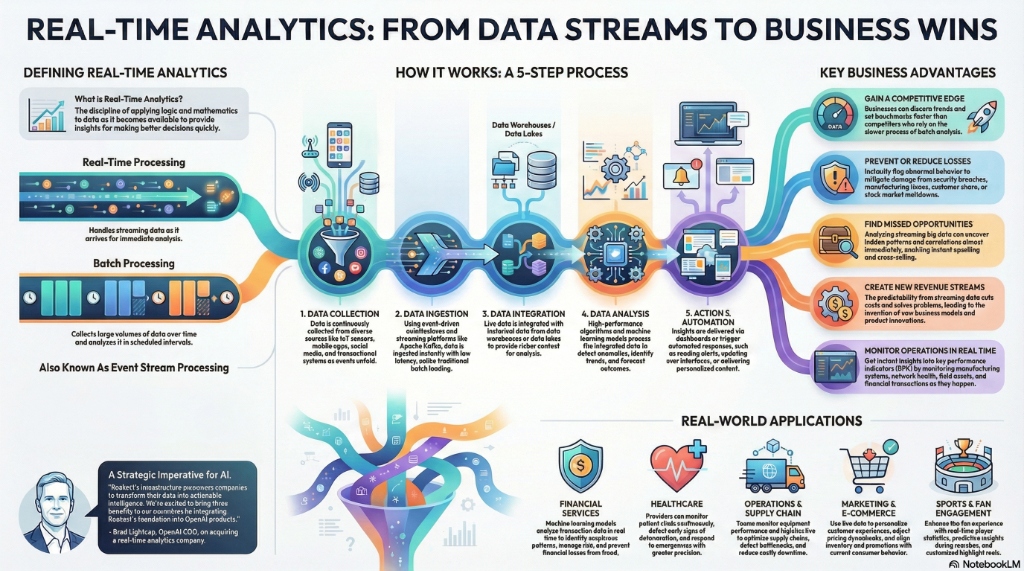
Real-Time Analytics: From Data Streams to Business Wins - Process Flow and Key Advantages
4.0 How It Works: The Journey from Raw Data to Instant Insight
The process of turning raw data into an immediate business action involves several distinct stages, all happening in near-instant succession.
- Data Collection: Data is continuously gathered from sources like IoT sensors, mobile apps, and social media.
- Data Ingestion: The system instantly takes in high volumes of data with low latency, often using streaming platforms like Apache Kafka.
- Data Integration: Live data is combined with historical data from data warehouses or data lakes to provide richer context.
- Data Analysis: Advanced algorithms and machine learning models analyze the data to identify trends, forecast outcomes, or detect anomalies.
- Action and Automation: Insights immediately trigger actions, such as sending alerts to staff, updating a dashboard, or delivering personalized content to a customer.
5.0 The Key Difference: Real-Time vs. Traditional Batch Analytics
Understanding the fundamental difference between modern real-time processing and traditional batch processing is key to appreciating its strategic value.
| Aspect | Batch Processing (The Traditional Way) | Real-Time Processing (The Modern Way) |
|---|---|---|
| Data Scope | Processes large volumes of historical data collected over time. | Processes continuous streams of data as it arrives. |
| Timing | Analyzed in scheduled intervals (e.g., nightly, weekly). | Analyzed within seconds or minutes of the data's arrival. |
| Best For | Monthly financial reporting, historical trend analysis. | Fraud detection, supply chain monitoring, personalizing live customer experiences. |
6.0 Unlocking Business Value: Core Benefits of Going Real-Time
Adopting a real-time analytics strategy delivers clear and measurable business benefits across the organization.
- Gain a Competitive Advantage: Outpace competitors who rely on the slower process of batch analysis by spotting trends and setting benchmarks faster.
- Cut Preventable Losses: Reduce the damage from incidents like security breaches, manufacturing issues, or customer churn by identifying abnormal behavior right away.
- Improve Operational Efficiency: Get instant insight into routine operations, monitor the health of networks or field assets, and optimize supply chains by detecting bottlenecks as they happen.
- Create New Revenue Opportunities: Uncover hidden patterns to immediately upsell and cross-sell to clients, leading to new business models and product innovations.
7.0 Real-Time Analytics Across Your Organization
Real-time analytics is not limited to a single department; its applications create value across the entire enterprise.
For Operations and Supply Chain Teams:
- Monitor equipment performance in real-time to reduce downtime.
- Optimize drilling operations.
- Track field assets like trucks and oil rigs to improve resource utilization.
For Marketing and Sales Teams:
- Personalize customer experiences and adjust pricing dynamically.
- Implement agile go-to-market strategies based on real-time market intelligence.
For Financial Institutions:
- Power fraud detection systems by analyzing transaction data in real-time to identify suspicious patterns.
- Leverage NoSQL databases for faster insights in FinTech applications.
For Healthcare Providers:
- Monitor patient vitals to detect early signs of deterioration.
- Use real-time mobile video analytics to assist pre-arrival emergency medical services.
8.0 Who is Using This Today? A Look at a Real-World Example
Leading technology companies are betting heavily on a real-time future. OpenAI, a leader in artificial intelligence, recently acquired Rockset, a leading real-time analytics database. As OpenAI's COO, Brad Lightcap, stated, "Rockset's infrastructure empowers companies to transform their data into actionable intelligence. We're excited to bring these benefits to our customers by integrating Rockset's foundation into OpenAI products." The strategic goal is clear: to enhance OpenAI's retrieval infrastructure, making its AI more helpful by allowing it to access and act on real-time information.
9.0 A Glimpse Under the Hood: Technologies Powering Real-Time Insights
While the business outcomes are the focus, it's helpful to know the names of the core technologies that make real-time analytics possible.
- Event Streaming (e.g., Apache Kafka): The digital nervous system that ingests and moves massive streams of data instantly.
- Stream Processing (e.g., Apache Spark, Apache Flink): The engines that perform the analysis and transformations on the data while it's in motion.
- Real-Time Databases (e.g., Rockset): Highly specialized databases built to index and retrieve information instantly, powering the rapid queries required by real-time applications.
- Unified Platforms (e.g., Azure, Databricks): Integrated solutions that bring together the tools needed to build, deploy, and manage data engineering, analytics, and AI on a single platform.
10.0 Best Practices for a Successful Implementation
To ensure your real-time analytics solution delivers on its promise, it's crucial to build it on a solid foundation. Key best practices include:
- Prioritize Security: Implement security best practices from the start to prevent, detect, and respond to potential data breaches.
- Design for High Availability: Ensure your database architecture is not a single point of failure to maintain continuous operations.
- Plan for Global Scale: If your users are geographically dispersed, design your system to be deployed in datacenters close to them to achieve low latency.
- Ensure Reliable Messaging: Use established patterns to guarantee the delivery of critical events and messages within your system.
11.0 Your High-Level Roadmap to Implementation
For business leaders, the path to implementing real-time analytics can be viewed as a strategic, five-phase roadmap.
- Identify & Collect: Pinpoint the critical, high-frequency data sources that reflect real-world events as they unfold.
- Ingest & Stream: Establish the technical foundation to handle high volumes of data with low latency.
- Integrate & Contextualize: Connect live data streams with existing historical data repositories to provide richer context for analysis.
- Analyze & Visualize: Deploy analytics and visualization tools, like dashboards, to surface trends and anomalies for decision-makers.
- Act & Automate: Define the automated responses, alerts, and actions that will be triggered by real-time insights to drive business value.
12.0 Key Takeaways for Business Leaders
- Real-time analytics is about making decisions with data as it's created, not after the fact.
- It provides a significant competitive advantage by enabling faster responses to market changes and operational issues.
- The technology is applicable across the entire organization, from supply chain and finance to marketing and customer service.
- Successful implementation starts with a clear business case and a focus on security, availability, and scale.
13.0 Conclusion: The Future is a Real-Time Enterprise
Real-time analytics is more than just a technological upgrade; it is the foundation for the next wave of business innovation. It powers advanced AI and data science models with a continuous flow of fresh data, ensuring they remain accurate and responsive to current conditions. This enables more precise predictive analytics, more effective intelligent automation, and hyper-personalized customer experiences that were previously impossible.
In a world where speed is paramount, mastering real-time data is the essential step toward becoming an agile, insight-driven, real-time enterprise.