Introduction: Beyond REST - Redefining Modern API Strategy
Modern API strategy has evolved far beyond a singular focus on REST. Today's architects embrace a multi-paradigm approach, selecting the right API style for the specific architectural challenge at hand. This shift is rooted in the "API-first" development model, where APIs are treated as foundational building blocks of software, not as afterthoughts. This model positions APIs as the connective tissue linking ecosystems of technologies and organizations, enabling businesses to innovate, forge partnerships, and unlock new value.
This guide moves through the foundational principles of REST to more advanced paradigms like GraphQL, gRPC, and Event-Driven APIs. It serves as a comprehensive manual for architects and technical leaders on the patterns, principles, and practices that define modern, scalable, and secure API ecosystems.
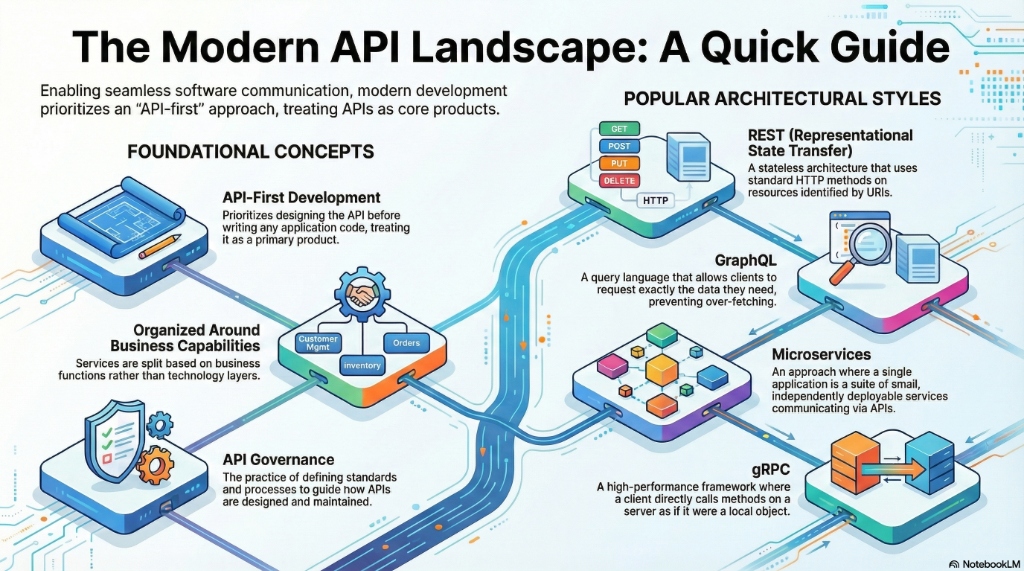
The Modern API Landscape: Foundational Concepts and Popular Architectural Styles
1. The Foundation: REST and the Richardson Maturity Model
REST remains the bedrock of modern API design, providing a set of constraints and principles that have guided web service development for years.
1.1. Core Principles of RESTful Design
A well-designed RESTful web API adheres to a set of core principles:
- Resources: Design is centered around business entities, or resources, which are identified by unique URIs. These URIs should be based on nouns (e.g., /orders/123), not verbs.
- Uniform Interface: Clients interact with resources using a standard set of operations through standard HTTP verbs like GET (retrieve), POST (create), PUT (update/replace), PATCH (partial update), and DELETE (remove).
- Statelessness: Every request from a client to the server must contain all the information needed to understand and complete the request. The server does not store any client state between requests.
- Resource Representations: Resources are decoupled from their representation. A client can request a resource in a specific format, such as JSON or XML.
1.2. The Richardson Maturity Model (RMM)
Introduced by Leonard Richardson and popularized by Martin Fowler, the Richardson Maturity Model provides a framework for understanding the different levels of adherence to REST principles. It outlines four levels of maturity:
- Level 0: The Swamp of POX (Plain Old XML) - Uses HTTP purely as a transport protocol for remote procedure calls (RPC). Typically a single service endpoint URI with all operations via POST requests.
- Level 1: Resources - Introduces the concept of distinct resources. Instead of a single service endpoint, the API exposes multiple URIs, each representing a specific business entity or resource.
- Level 2: HTTP Verbs - Utilizes the full uniform interface of HTTP. Uses standard HTTP verbs for operations and leverages HTTP status codes to communicate outcomes (e.g., 201 Created for success, 409 Conflict for an error).
- Level 3: Hypermedia Controls (HATEOAS) - The highest level of maturity. Resource representations include links that guide the client on what actions can be taken next. This allows a client to navigate the API without prior knowledge of the URI schema, decoupling the client from the server's URI structure.
1.3. Specification-Driven Development with OpenAPI
The OpenAPI Specification (OAS) is a standard, programming language-agnostic interface description for HTTP APIs. As a Linux Foundation project, it provides a formal standard that allows both humans and computers to understand an API's capabilities without access to source code. An OAS document enables a contract-first approach, where the API definition is used to generate documentation, client and server code, and automated tests.
2. Advanced Paradigms: Choosing the Right Tool for the Job
While REST is a powerful foundation, modern architectures require a diverse toolkit. Different API styles have emerged to solve specific challenges that REST is not always optimized for.
2.1. GraphQL: Flexible Queries for Complex Data
GraphQL is a query language for APIs that gives clients the power to ask for exactly the data they need, and nothing more. This solves the common REST problem of over-fetching and under-fetching.
- Schema-Centric Design: A GraphQL API is defined by a strongly-typed schema that acts as a contract between the client and server.
- Queries and Mutations: The API is structured around Queries (for fetching data) and Mutations (for writing or modifying data).
- Supergraph Architecture: Composes multiple backend GraphQL services (subgraphs) into a single, unified graph for federated API development.
- Connectors and Resolvers: Resolvers contain the logic to fetch data for a field, while connectors provide a declarative pattern for orchestrating calls to backend data sources.
2.2. gRPC: High-Performance Binary RPC
gRPC is a high-performance, open-source Remote Procedure Call (RPC) framework that allows a client application to directly call methods on a server on a different machine as if it were a local object.
- Protocol Buffers (Protobuf): Uses Protocol Buffers as its Interface Definition Language (IDL) for serializing structured data.
- Binary Protocol: Serializes structured data into a compact binary format, making it significantly faster than text-based protocols like JSON.
- HTTP/2 Foundation: Built on HTTP/2, leveraging features like multiplexing and bidirectional streaming.
- Real-World Use: Companies like Netflix have adopted gRPC for optimizing communication within their microservice architecture.
2.3. Event-Driven APIs: Asynchronous and Real-Time Communication
Contrasting with the synchronous request-response model, event-driven architectures enable asynchronous communication, ideal for decoupling services and handling real-time notifications.
- Publish/Subscribe (Pub-Sub): Services (publishers) send messages to a topic on a lightweight message bus without knowing who the receivers (subscribers) are, creating a highly decoupled system.
- AsyncAPI Specification: Provides a standard for defining asynchronous, event-driven APIs, serving a similar role as OpenAPI does for REST.
3. Architectural Patterns in a Distributed World
APIs are a critical part of broader system architectures, particularly in distributed environments like microservices.
3.1. Microservices Communication Patterns
In a microservice architecture, communication between services is paramount:
- Synchronous Communication: Request-response pattern where the client blocks until it receives a response. REST and gRPC are common protocols. While simple, it introduces temporal coupling.
- Asynchronous Communication: Uses messaging or events where a service sends a message without waiting for an immediate reply. Promotes "smart endpoints and dumb pipes," improving resilience and decoupling.
An architect's choice between REST/gRPC (synchronous) and event-driven APIs (asynchronous) directly reflects their strategy for managing temporal coupling and system resilience.
3.2. API Gateway Patterns
An API Gateway acts as a single "front door" for client applications to access data and functionality from backend services:
- Request Routing: Directs incoming API calls to the appropriate backend microservice.
- API Composition/Aggregation: Combines results from multiple internal services into a single, unified response.
- Protocol Translation: Exposes a consistent API style (like REST or GraphQL) to external clients while communicating with internal microservices using different protocols (like gRPC).
- Cross-Cutting Concerns: Offloads common responsibilities like authentication, access control, rate limiting, monitoring, and caching.
- Backend for Frontend (BFF): Provides a tailored API for specific client experiences (e.g., mobile vs. web).
3.3. API Lifecycle Management and Governance
API governance is the practice of applying consistent policies, standards, and processes to guide how APIs are designed, built, published, and maintained.
- Take Inventory: Gain a complete view of the organization's API landscape.
- Define Policies: Establish consistent standards for API design, security protocols, and versioning strategies.
- Enable Teams: Foster a governance-oriented culture through advocacy, training, and support.
- Automate Checks: Augment manual reviews with automated governance checks within the CI/CD pipeline.
4. Essential API Design and Implementation Patterns
These practical patterns apply across most API styles and are crucial for building robust, user-friendly APIs.
4.1. Versioning Strategies
Versioning is necessary to evolve an API over time without breaking existing client applications:
| Strategy | Description | Example |
|---|---|---|
| URI Versioning | Version number included directly in the URI path | https://api.contoso.com/v2/customers/3 |
| Query String Versioning | Version specified as a query parameter | https://api.contoso.com/customers/3?version=2 |
| Custom Header Versioning | Version requested using a custom HTTP header | Custom-Header: api-version=2 |
| Media Type Versioning | Version included in Accept header with custom media type | Accept: application/vnd.contoso.v1+json |
4.2. Data Handling: Pagination, Filtering, and Sorting
When dealing with large datasets, it's critical to provide clients with data management mechanisms:
- Pagination: Return large collections in smaller chunks using limit and offset query parameters (e.g., /orders?limit=25&offset=50).
- Filtering: Allow clients to refine results by applying conditions via query parameters (e.g., ?status=shipped).
- Sorting: Enable clients to order returned data by a specific field (e.g., ?sort=price).
4.3. Ensuring Reliability: Idempotency and Error Handling
- Idempotency: Making the same request multiple times produces the same result as making it once. Critical for safely retrying failed requests. PUT and DELETE verbs must be implemented to be idempotent.
- Error Handling: Use standard HTTP status codes (4xx for client errors, 5xx for server errors) and return structured, machine-readable error messages.
5. Security and Operations
Non-functional requirements are just as important as the API's features. A production-ready API must be secure, performant, and observable.
5.1. Authentication and Authorization
Common security schemes include:
- API Keys: A secret token passed in a request header, query parameter, or cookie.
- HTTP Authentication: Standard schemes like Basic or Bearer tokens.
- OAuth 2.0: Industry-standard framework for delegated authorization with flows like Authorization Code and Client Credentials.
- JSON Web Tokens (JWT): Compact, self-contained format for bearer tokens.
- Mutual TLS (mTLS): Strong authentication where both client and server present and validate SSL certificates.
5.2. API Security Fundamentals
- The OWASP API Security Top 10 is a critical awareness document outlining the most common security vulnerabilities in APIs.
- Adopting a "Zero Trust" mindset is a core principle for securing modern software supply chains.
5.3. Performance and Caching
Caching is a key strategy for improving API performance:
- In HTTP, GET requests are cacheable by design. Proxies and clients can cache responses to avoid redundant calls.
- The HEAD request method retrieves resource headers without fetching the entire response body, allowing clients to determine if cached copies are still valid.
5.4. API Observability
The three pillars of observability for APIs:
- Logging: Recording detailed, time-stamped events and errors for debugging specific issues.
- Metrics: Aggregating numerical data about API usage and performance over time (request rates, latency, error rates).
- Tracing: Tracking a single request as it propagates through a distributed system of multiple microservices.
6. Patterns in Practice: Real-World Case Studies
Leading technology companies provide excellent examples of how these API patterns are applied:
- Stripe: A quintessential API-first company. Their engineering culture emphasizes reliability and they are pioneering new standards like the Agentic Commerce Protocol (ACP) in collaboration with OpenAI.
- Twilio: Twilio's APIs are organized around REST principles to provide foundational communication building blocks for messaging and voice calls.
- GitHub: A prime example of multi-paradigm API strategy, offering both a comprehensive REST API and a flexible GraphQL API.
- Netflix: As a pioneer of microservice architecture at scale, Netflix leverages gRPC for highly efficient internal communication between their vast network of microservices.
7. The Future of APIs: AI, Automation, and Intelligence
The API landscape is continually evolving, with AI and automation driving the next wave of innovation:
- AI-Driven and Agentic APIs: Designing APIs for consumption by AI agents and Large Language Models (LLMs), leading to concepts like the "AI Gateway" and new standards like the "Agentic Commerce Protocol."
- Connecting AI to APIs: New platforms like the Apollo MCP Server are emerging to bridge this gap, enabling AI to interact with the world's data and services securely and efficiently.
- Declarative and Automated API Management: Moving towards declarative configurations and automated lifecycle management to manage complexity at scale.
8. Conclusion: Key Takeaways for the Modern Architect
A successful API strategy is no longer about choosing one tool, but about mastering many:
- Embrace a Multi-Paradigm Approach: Modern API design is about having a strategic toolkit. Choose the best paradigm—REST, GraphQL, gRPC, or event-driven—for the specific problem you are solving.
- Prioritize Governance, Security, and Observability: As APIs become the central nervous system of the enterprise, robust governance, zero-trust security, and deep observability are critical.
- Design for Evolution: APIs are products with a lifecycle. Plan for change through deliberate versioning, build for resilience with patterns like idempotency, and design for discoverability with hypermedia controls.
In the modern digital economy, a well-architected API strategy is not just a technical detail—it is a significant and sustainable competitive advantage.