Introduction: More Than a Move, It's a Strategic Imperative
Is your IT infrastructure an engine for innovation or an anchor holding you back? In today's competitive landscape, the decision to migrate to the cloud is a fundamental business strategy, not a simple IT project. For modern leaders, this is about positioning your organization to accelerate innovation, reduce infrastructure costs, lower time-to-market for new features, and optimize expensive software licensing.
The shift is already well underway. Tech analysts predict that a staggering 75% of organizations will adopt cloud-based data infrastructure by 2026. A successful cloud migration is the critical first step toward building a more agile, resilient, and forward-thinking enterprise, ready to capitalize on the next wave of technological advancement.
1. Decoding the Cloud: Key Concepts for Decision-Makers
Before charting your course, it's essential to understand the foundational concepts that will shape your strategy. This section demystifies the core terminology for a non-technical audience.
1.1. What is Cloud Migration?
At its core, cloud migration is the process of moving your organization's data, applications, and workloads from an on-premises data center to a cloud-based infrastructure. This can also include moving assets from one cloud environment to another. It is the tactical execution of a strategic decision to leverage the power and flexibility of the cloud.
1.2. Understanding Your Cloud Environment Options
Your cloud environment is the foundation of your digital infrastructure. The model you choose will depend on your specific needs for security, control, flexibility, and cost.
- Public Cloud: Services and infrastructure are owned and operated by a third-party cloud provider (like AWS or Microsoft Azure) and delivered over the public internet. Think of it like the public electricity grid. You pay for what you use, and the provider manages all the complex infrastructure.
- Private Cloud: A secure, proprietary cloud infrastructure that is operated solely for a single organization. This is like having your own power generator. It offers maximum control and security but requires you to manage and maintain it.
- Hybrid Cloud: A strategic combination of public and private clouds, creating a single, flexible, and cost-effective IT infrastructure. This model is the best of both worlds, like using the public grid for most of your needs but keeping a private generator for your most critical, sensitive operations.
- Multicloud: An approach that utilizes services from more than one public cloud provider. This strategy helps avoid vendor lock-in and allows an organization to select the best services from different providers for specific needs.
1.3. Section Takeaway
The choice between public, private, hybrid, or multicloud is not a technical detail but a strategic business decision. The right model is the one that best aligns with your organization's specific security requirements, cost structure, and long-term flexibility goals.
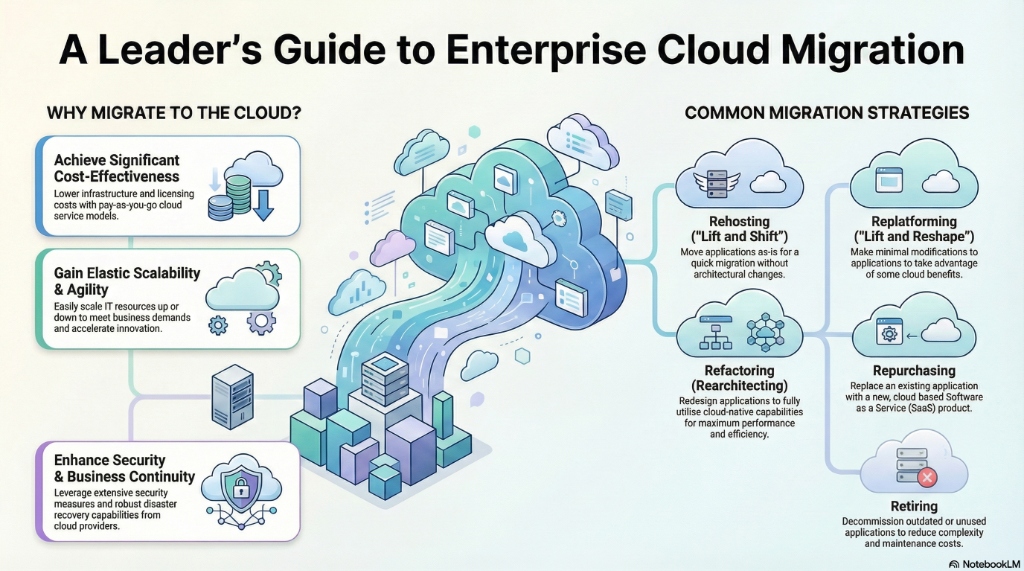
A Leader's Guide to Enterprise Cloud Migration - Key Concepts and Common Strategies
2. The 5 "R"s of Migration: Choosing Your Strategic Approach
Not all applications should be moved to the cloud in the same way. Selecting the right migration strategy for each workload is critical to maximizing your return on investment and ensuring a smooth transition. The five most common strategies, often called the "5 R's," provide a framework for these decisions.
| Strategy | Description | Best For (Business Use Case) |
|---|---|---|
| Rehosting (Lift-and-Shift) | Migrating applications and data from on-site infrastructure to a cloud platform without making significant changes to the architecture. | Quickly moving applications to the cloud to meet a pressing deadline, such as a data center closure, with minimal immediate changes. |
| Replatforming (Lift-and-Reshape) | Making specific, minimal changes to an application's architecture—such as moving to a managed database service or using containers—to gain cloud benefits without a full rewrite. | Modernizing applications to gain cloud benefits (like managed databases or containers) without the time and expense of a complete rewrite. |
| Refactoring (Rearchitecting) | Redesigning and redeveloping applications to fully utilize cloud-native capabilities, maximizing scalability, resilience, and efficiency. | Mission-critical applications where maximizing the long-term business value of the cloud is the primary goal. |
| Repurchasing | Retiring an existing legacy application and replacing it with a modern, cloud-based Software as a Service (SaaS) alternative. | Replacing non-core legacy systems like HR, CRM, or email with best-in-class SaaS solutions to reduce management overhead. |
| Retiring | Decommissioning outdated or unused applications that are identified during the assessment process. | Reducing maintenance costs, eliminating redundant IT resources, and streamlining the migration by focusing only on critical applications. |
2.1. Section Takeaway
A successful migration strategy is not a one-size-fits-all approach. Leaders must direct their teams to assess the entire application portfolio, assigning the most appropriate "R" strategy to each workload based on its business value, technical complexity, and strategic importance.
3. Your Migration Roadmap: A Phased Approach to Success
A structured plan is essential to avoiding common pitfalls like budget overruns and timeline delays. Proven methodologies like the Microsoft Cloud Adoption Framework (CAF) provide a roadmap validated across thousands of organizational deployments spanning Fortune 500 enterprises to startups.
3.1. Phase 1: Strategy & Assessment
This phase is about building the business alignment necessary to ensure the migration is not just an IT project, but a core business initiative. It is the foundation upon which the entire project is built.
- Articulate the business case for migration, defining the "why" behind the move.
- Assess existing IT infrastructure, applications, and data dependencies to identify what to move and how.
- Establish migration goals, priorities, and success metrics to ensure the project delivers quantifiable business outcomes.
3.2. Phase 2: Plan & Ready
This phase is about translating strategy into a detailed blueprint for execution, ensuring the organization is fully prepared for the transformation.
- Select the cloud provider that best aligns with your business needs, technical requirements, and existing capabilities.
- Design the target cloud architecture, with a clear focus on security, compliance, resilience, and cost-efficiency.
- Prepare people, processes, and technology for the transformation, ensuring organizational readiness for the new operating model.
3.3. Phase 3: Adopt & Migrate
Success in this phase is measured not just by technical deployment, but by validating the intended business value through rigorous testing and user feedback.
- Deploy production workloads in the new cloud environment according to the plan.
- Conduct rigorous functional, performance, and security testing to validate that applications are working correctly and securely.
- Gather feedback through user acceptance testing to confirm that the end-user experience meets or exceeds expectations.
3.4. Section Takeaway
A methodical, phased approach, as outlined by frameworks validated across thousands of organizational deployments spanning Fortune 500 enterprises to startups, significantly reduces migration risks and ensures that the project remains aligned with strategic business objectives from start to finish.
4. Navigating Key Challenges: Governance, Security, and Cost
A proactive approach to cloud transformation requires treating governance, security, and cost not as separate silos, but as interconnected pillars of a sound cloud strategy. Robust governance, for instance, is the mechanism that enforces both security policies and cost controls. Addressing these challenges from the outset is critical.
4.1. Establishing Governance and Compliance
Robust governance is essential for maintaining control, ensuring compliance, and optimizing costs in the cloud. From day one, it's critical to define clear governance policies and automate compliance enforcement, especially when operating in regulated industries that must adhere to standards like SOC 2, PCI DSS, or HIPAA.
4.2. Fortifying Security
While cloud providers implement extensive measures to protect data, security remains a shared responsibility. The cloud enables a more robust security posture through modern approaches like a "zero-trust" model, where no user or device is trusted by default, and continuous threat monitoring to protect workloads against evolving cyber threats.
4.3. Mastering Cost Optimization
A primary executive concern is the risk of uncontrolled spending. The cloud's pay-as-you-go model offers significant cost-effectiveness, but it must be managed. Implementing proven patterns for resource rightsizing and cost management ensures you only pay for what you need and that your cloud investment is continuously optimized.
5. Real-World Success: Learning from Enterprise Leaders
The best practices for cloud migration are not theoretical; they are proven by the success of enterprises that have already navigated this journey.
Salesforce: Fueling Innovation at Scale
To meet the demands of its global customer base, Salesforce faced the challenge of scaling its Marketing Cloud platform. By strategically migrating the entire platform to AWS, Salesforce leveraged a more flexible and scalable infrastructure, enabling the company to innovate faster and deliver enhanced services worldwide.
Citizens Bank: Enhancing the Digital Customer Experience
Citizens Bank aimed to improve its digital banking services and accelerate feature deployment. Through a mainframe modernization initiative with AWS, the bank moved core applications to the cloud, gaining the agility needed to develop and roll out new digital experiences that directly improve how customers interact with their services.
Thomson Reuters & Experian: Accelerating Transformation with AI
Facing the complex task of modernizing legacy .NET applications, Thomson Reuters used an AI-powered tool that resulted in cutting costs by 30% while boosting transformation speed by an incredible 4x. Similarly, Experian used Agentic AI to automate 687,600 lines of code transformation, showcasing how advanced tools can turn a daunting migration challenge into a profound efficiency gain.
6. Beyond Day One: Continuous Optimization and Management
The migration itself is not the finish line; it is the beginning of a new, more dynamic operational model. Post-migration success depends on a commitment to continuous management and optimization.
- Continuous Performance Monitoring: This requires a dedicated focus on fine-tuning applications and streamlining resource usage to guarantee optimal and efficient performance in the new environment.
- Cost Management (FinOps): This requires establishing a continuous FinOps discipline to actively monitor and optimize cloud spend, ensuring every dollar delivers maximum business value.
- Driving Continuous Improvement: This means leveraging automation and DevOps best practices to achieve operational excellence, allowing your teams to manage the new environment efficiently and focus on innovation rather than routine maintenance.
Conclusion: Your Foundation for an AI-Ready Future
A well-executed cloud migration is more than an infrastructure upgrade; it is the foundational step toward securing a long-term competitive advantage. It streamlines IT operations and reduces costs today, but more importantly, it makes your organization future-ready.
By building a scalable, secure, and flexible cloud foundation, you unlock the ability to rapidly adopt and integrate transformative technologies like generative AI, advanced analytics, and the Internet of Things (IoT). Leaders who embrace this transformation are not just building a more efficient business for today—they are building an innovation engine for tomorrow.